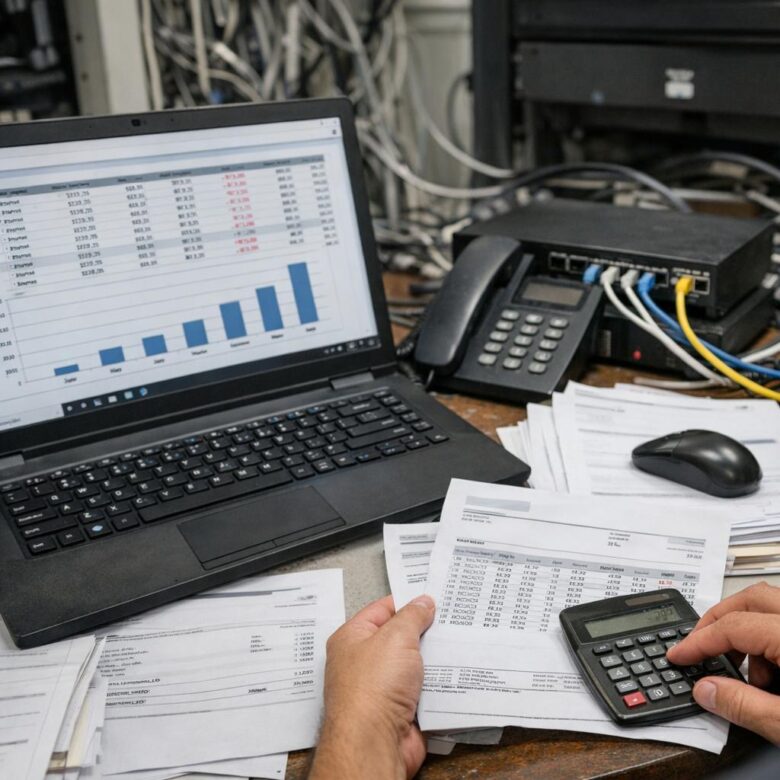
Historical telecom billing errors are rarely obvious. They usually appear as small recurring differences: a disconnected circuit that remains on the bill, an expired discount, a duplicated service, an incorrect rate, an unidentified mobile line, or a credit that was promised but never applied. Automation helps organizations compare large volumes of invoice data with contracts, inventory, orders, usage, and payment records—but a human review is still required before an exception becomes a valid recovery claim.
Find recurring errors
Compare months of invoices to detect charges that changed, duplicated, continued after cancellation, or failed to match a contract.
Validate the evidence
Match each exception with a service order, contract term, inventory record, usage report, disconnect notice, or carrier confirmation.
Prevent the error returning
Convert successful audit rules into recurring controls for future invoices, renewals, service changes, and employee offboarding.
What Automated Telecom Invoice Auditing Actually Does
Automated invoice auditing imports carrier bills and converts them into a consistent data structure. It can then compare billed services with contracts, approved pricing, service inventory, user assignments, usage, orders, credits, and previous invoices.
The system does not automatically prove that every difference is a billing error. A charge may be valid because of a contract amendment, location change, usage event, tax rule, equipment installment, or service request that has not yet reached the internal inventory. Automation identifies exceptions; finance, IT, procurement, and service owners validate them.
Billing Errors That Automation Can Help Detect
| Error pattern | Example | Data needed for validation | Possible resolution |
|---|---|---|---|
| Post-disconnect billing | A circuit, SIM, toll-free number, or cloud seat remains billed after an approved cancellation date. | Disconnect order, completion notice, inventory status, final usage, and invoice history. | Stop future billing and request eligible credits from the documented effective date. |
| Incorrect contract rate | The carrier bills a standard rate instead of the negotiated rate shown in the agreement or amendment. | Signed contract, amendment, service identifier, effective date, rate table, and invoice line. | Correct the recurring rate and submit a calculated historical adjustment request. |
| Duplicate service | The same circuit, telephone number, device, or feature appears more than once under one or multiple billing accounts. | Circuit IDs, telephone numbers, service addresses, device IDs, account numbers, and order records. | Confirm which service is valid, remove the duplicate, and request applicable credits. |
| Missing credit | A promised promotional, installation, outage, migration, or contract credit never appears. | Written commitment, ticket number, credit amount, expected invoice, and subsequent bills. | Request the missing credit with the original written approval. |
| Unowned service | A billed mobile line, device, circuit, license, or feature has no current employee, site, department, or business purpose. | HR records, device inventory, cost centers, usage, location data, and service ownership records. | Investigate before canceling, then disconnect or reassign the service when appropriate. |
| Expired discount | A temporary discount ends, but no one reviews whether the new price remains appropriate or contractually correct. | Offer terms, expiration date, renewal agreement, service usage, and alternative pricing. | Verify whether the increase is correct, renegotiate, or change the service. |
| Unauthorized feature | Insurance, international access, premium support, call features, or third-party services appear without a valid approval record. | Order history, user approval, service configuration, usage, and carrier records. | Remove unnecessary features, block future enrollment, and dispute unauthorized charges where supported. |
| Quantity mismatch | The invoice contains more licenses, seats, channels, lines, or devices than the organization ordered or currently uses. | Purchase order, contract quantity, platform report, inventory, and invoice detail. | Correct the billable quantity and align future orders with inventory. |
The Automated Audit Workflow
Step-by-Step Historical Audit Process
Define the audit scope and recovery period
Decide which carriers, accounts, countries, service types, and billing periods will be reviewed. Read the contract before selecting the historical period. The available dispute window may differ by carrier, service, account, and jurisdiction.
Gather the complete source records
Collect invoice summaries, line-level details, contracts, amendments, quotes, rate tables, purchase orders, service orders, disconnect confirmations, trouble tickets, credits, payment records, inventory, device assignments, and usage reports. Missing source data increases false positives and weakens disputes.
Preserve the original documents
Store unmodified invoice and contract files in a controlled location. Record the source, account, billing period, import date, and file version. Historical evidence should remain traceable even after data is converted into a spreadsheet or database.
Normalize the billing data
Carriers may use different names for the same service and may change invoice formats over time. Create consistent fields for account number, invoice date, service identifier, service address, telephone number, charge type, quantity, rate, tax, credit, usage, and cost center.
Create a reliable service identity
Match charges using more than a description. Depending on the service, use circuit IDs, telephone numbers, SIM identifiers, device IDs, service addresses, trunk names, license IDs, billing account numbers, or order numbers. A single service may move between billing accounts during its lifecycle.
Load contract and order rules
Record contracted rates, quantities, discounts, minimum commitments, installation fees, renewal dates, notice periods, service-level credits, termination terms, and approved exceptions. Assign effective dates so the system does not apply a current price to an older billing period.
Run exception tests
Compare recurring charges across months, billed rates against contract rates, active billing against inventory, quantities against orders, and usage against service status. Flag changes that exceed a defined tolerance instead of treating every rounding difference as an error.
Validate exceptions with business owners
Ask IT whether the service is active, procurement whether the rate is contracted, finance whether credits were received, HR whether a user remains employed, and site managers whether a location is still open. Do not cancel an unknown service until its operational role is confirmed.
Calculate the eligible recovery amount
Calculate the difference for each affected billing period, then account for partial months, previous credits, taxes, contract limitations, foreign exchange treatment, and any disputed quantities. Keep the gross suspected amount separate from the amount supported by evidence.
Build and submit a dispute package
Include the affected invoices, service identifiers, disputed line items, contract references, effective dates, calculations, supporting orders, requested correction, and responsible contact. Submit the claim through the channel and within the deadline specified by the carrier.
Track credits through final reconciliation
A carrier approval is not the same as a received credit. Record the approved amount, reference number, expected invoice, actual invoice, posted amount, remaining balance, and future rate correction. Confirm that the same error does not continue on later bills.
Convert findings into recurring controls
Add successful tests to the monthly audit process. Connect service orders with accounts payable, update inventory after every change, and create alerts for rate increases, unknown services, missing credits, zero-use lines, and billing after disconnection.
Data Sources Needed for a Reliable Audit
Carrier and financial records
- Invoice summaries and line-level billing details
- Account and billing hierarchy
- Usage and call-detail records where appropriate
- Payments, credits, adjustments, and disputes
- Carrier portal exports and service inventories
- Tax and surcharge descriptions
Internal business records
- Contracts, amendments, quotes, and rate cards
- Purchase orders and approval records
- Install, move, add, change, and disconnect orders
- Network, device, number, license, and circuit inventory
- HR assignments, locations, and cost centers
- Support tickets and service acceptance records
The invoice is only one side of the audit. A billing platform can show that a charge exists, but contracts, inventory, orders, usage, and business ownership determine whether the charge is correct. The quality of the result depends on the quality of the connected data.
Hypothetical Historical Recovery Example
A disconnected data circuit remains on the invoice
A business finds a circuit billed at $875 per month even though a completed disconnect order shows that the service should have ended nine months earlier. The carrier previously applied a $400 general account credit that must be excluded from the new claim.
This calculation is only a starting point. The final eligible amount depends on the contract, dispute deadline, effective cancellation date, partial-month rules, taxes, prior adjustments, and the evidence accepted by the carrier.
Historical Overcharge Estimator
Enter a suspected recurring monthly overcharge, the number of affected months, and any credits already received.
This calculator provides an arithmetic estimate only. It does not confirm that a charge is incorrect or recoverable. Contract terms, claim windows, taxes, partial months, prior adjustments, and available evidence must be reviewed separately.
How to Prioritize Audit Exceptions
Reviewing every exception in the order it appears can waste time. A useful queue considers financial value, evidence quality, claim deadline, recurrence, operational risk, and the effort required to validate the issue.
High-value and time-sensitive
Large recurring charges, billing after documented cancellation, contract-rate errors, approaching dispute deadlines, and active errors that continue growing each month.
Material but incomplete
Exceptions with meaningful value that still require an order record, owner confirmation, contract amendment, service test, or carrier explanation.
Low-value or low-confidence
Small one-time differences, rounding issues, ambiguous descriptions, and items whose validation cost may exceed the likely recovery.
Building a Strong Carrier Dispute Package
Evidence should answer five questions
- What was billed? Identify the invoice, account, service, charge description, quantity, rate, and amount.
- Why is it incorrect? Cite the contract, order, cancellation, approved rate, usage record, or other source.
- When did the error begin? Provide the first affected invoice and the relevant effective date.
- How was the amount calculated? Show each billing period, expected amount, billed amount, prior credit, and difference.
- What resolution is requested? Specify a credit, rate correction, service removal, tax review, or written explanation.
Keep all submissions, attachments, ticket numbers, emails, call notes, approval messages, credit commitments, and revised invoices. Use a unique internal case number so the exception remains traceable across finance, IT, procurement, and carrier support.
Warning Signs in Historical Telecom Data
- A disconnected service continues billing in later months
- The same circuit or number appears under multiple accounts
- A recurring rate changes without a matching amendment
- A promised credit never appears on the expected invoice
- Inactive locations still have circuits, trunks, or telephone lines
- Mobile lines have no employee, device, or cost-center owner
- Quantities exceed the licenses or channels visible in the platform
- Charges remain constant even after a documented downgrade
- One-time installation or activation fees appear repeatedly
- Old technology remains billed after a completed migration
- Taxes are calculated using an outdated service address
- Account totals change while usage and inventory remain unchanged
Controls That Prevent New Billing Errors
Do not approve a new recurring charge until it matches an authorized order, service identifier, agreed rate, and responsible cost center.
Keep the change open until the service is technically disconnected and removed from the next invoice.
Store rates with effective dates so audit rules apply the correct agreement to each historical billing period.
Assign every circuit, line, device, number, trunk, and license to a current owner, location, department, and business purpose.
Track promised credits until the exact amount is visible and verified on a carrier invoice.
Flag material changes in rate, quantity, usage, tax, surcharge, and total cost before the invoice is approved.
Connect HR departures and office closures with device recovery, service review, forwarding removal, and carrier cancellation tasks.
Record the applicable claim window for each contract and alert owners before a potential recovery expires.
Common Automation Mistakes
The system can identify changes but cannot reliably determine the expected rate or approved quantity.
Service changes, usage, taxes, amendments, and one-time projects can create legitimate differences.
Applying today’s contract rate to older invoices can create false recovery calculations.
Carrier naming can change. Reliable matching also uses service IDs, numbers, addresses, devices, accounts, and orders.
Recurring errors and missing credits become clearer when several billing periods are compared.
A poorly documented circuit may still support a critical location, alarm, payment terminal, elevator, or emergency service.
The case is not complete until the credit posts and future billing is corrected.
An old internal record can cause the same service to be reordered, overlooked, or incorrectly disputed later.
Implementation Checklist
- Define carriers, accounts, services, and historical periods in scope
- Confirm contractual and legal dispute windows before analysis
- Preserve original invoices, contracts, orders, and confirmations
- Create consistent fields across different carrier formats
- Assign stable identifiers to lines, devices, circuits, and licenses
- Load contract rates with correct effective and expiration dates
- Connect billing with inventory, HR, procurement, and usage data
- Set tolerances for rounding and immaterial differences
- Require human validation before opening a carrier dispute
- Calculate suspected and evidence-supported amounts separately
- Keep a complete record of each submission and carrier response
- Track approved credits until they appear on an invoice
- Confirm that recurring billing is corrected after resolution
- Turn validated findings into monthly audit rules
- Review permissions for invoice, contract, and employee information
- Measure avoided future cost separately from recovered historical cash
Frequently Asked Questions
How many months of invoices should be reviewed?
Review the available period that is relevant to the suspected issue, but first confirm the dispute window in the applicable contract, invoice terms, tariff, and law. A longer dataset can improve pattern detection even when not every period remains eligible for recovery.
Can invoice audit software prove that a carrier made an error?
Not by itself. Software can identify a difference or suspicious pattern. Contracts, orders, service records, usage, inventory, carrier confirmations, and human review establish whether the charge is actually incorrect.
Should every small billing difference be disputed?
Not necessarily. Consider the total recurring impact, evidence quality, deadline, operational risk, and cost of validation. A small difference affecting hundreds of lines may deserve higher priority than a larger one-time item with weak evidence.
What is the difference between recovery and cost avoidance?
Recovery is money credited or refunded for eligible past billing. Cost avoidance is future spending prevented by correcting a recurring charge, canceling an unnecessary service, or improving a control. Track them separately to avoid overstating results.
Can optical character recognition be used for PDF invoices?
Yes, but extracted values should be validated. Scanned documents, changing layouts, small text, negative values, taxes, and multi-page line items can produce recognition errors. Preserve the original PDF and compare imported totals before using the data in a dispute.
Who should own the audit process?
Shared ownership usually works best. Finance controls payments and credits, IT understands services and usage, procurement owns contracts, HR supports user lifecycle data, and department managers confirm business need.
When is a historical audit complete?
The audit is complete when validated cases are resolved, credits are reconciled, recurring charges are corrected, inventory is updated, and the organization has added controls to detect the same error in future invoices.
Final Takeaway
Historical telecom recovery is not created by scanning invoices alone. It comes from connecting billing data with contracts, service inventory, orders, usage, employee records, and carrier evidence. Automation makes that comparison faster and more repeatable, while human validation turns exceptions into defensible disputes.
Begin with high-value recurring errors and items approaching a claim deadline. Preserve the source documents, calculate each period clearly, track credits until they post, and convert confirmed findings into monthly controls. The best audit does more than recover eligible past costs—it stops the same billing problem from continuing.
Official Resources
This article is provided for general informational purposes. Carrier contracts, billing formats, tax treatment, claim windows, dispute procedures, and credit policies vary by provider, account, service, and jurisdiction. Verify important details using the applicable agreement and current official documentation.

The TMPCom Editorial Team creates practical, research-based content about business telecommunications, VoIP systems, network security, compliance, and telecom cost management. Our articles are developed using official documentation, technical standards, and reputable industry sources to help businesses make clearer and more informed technology decisions.