A recorded business call may contain names, account details, financial information, health information, employee data, or confidential conversations. Compliance therefore depends on much more than playing a short announcement. Organizations need a documented purpose, an appropriate legal basis, restricted access, secure vendors, defensible retention rules, and a process for handling requests and incidents.
Record for a defined reason
Document why recording is necessary and avoid collecting entire conversations when a narrower method can achieve the same purpose.
Protect the complete lifecycle
Security must cover capture, transfer, storage, playback, transcription, export, backup, legal hold, and deletion.
Keep evidence of compliance
Maintain notices, assessments, access logs, vendor agreements, retention rules, training records, and incident documentation.
GDPR and HIPAA Do Not Regulate the Same Thing
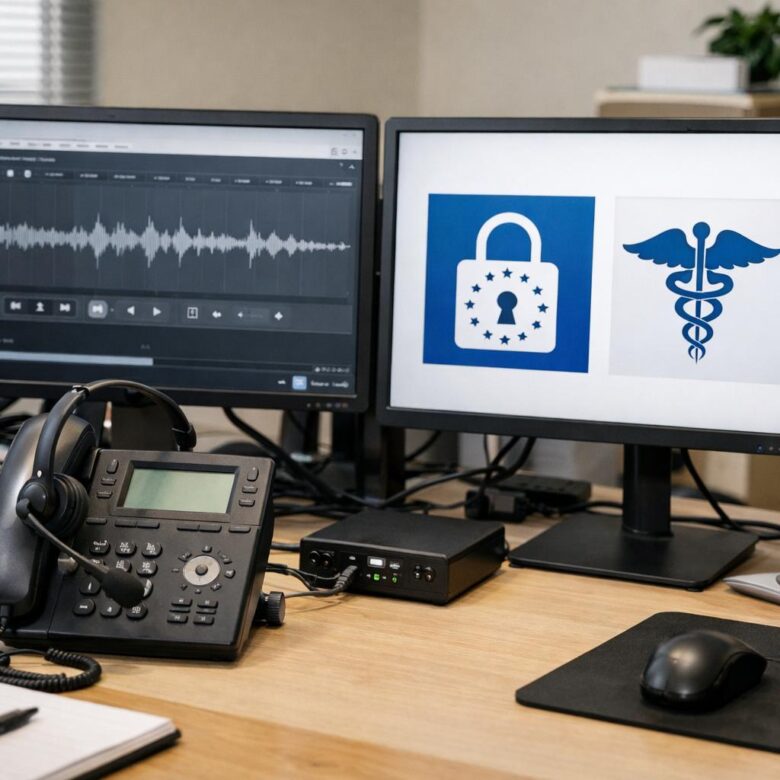
The General Data Protection Regulation and HIPAA can both affect recorded calls, but they have different scopes. Treating them as interchangeable can lead to incorrect consent scripts, incomplete security controls, and unnecessary collection.
| Question | GDPR | HIPAA |
|---|---|---|
| What does it protect? | Personal data relating to identifiable individuals. Recorded voices, telephone numbers, account details, metadata, and transcripts may all qualify. | Protected health information handled by covered entities and business associates. The Security Rule specifically protects electronic PHI. |
| Who is generally covered? | Organizations within its territorial scope, including certain organizations outside the EEA that offer goods or services to, or monitor, people in the EEA. | Health plans, health care clearinghouses, certain health care providers, and business associates performing covered functions or services involving PHI. |
| Is consent always required? | No. Processing requires an appropriate lawful basis. Consent is one possible basis, but contract necessity, legal obligation, public task, vital interests, or legitimate interests may apply in appropriate circumstances. | HIPAA does not create a universal patient-consent requirement for every recorded call. Permitted uses and disclosures depend on the purpose and circumstances. Separate recording-consent laws may still apply. |
| What about health information? | Health data is a special category of personal data. An organization generally needs both an Article 6 lawful basis and an applicable Article 9 condition. | A recording containing identifiable health information may become PHI when it is created or received by a covered entity or business associate in a covered context. |
| Core operational focus | Lawfulness, fairness, transparency, purpose limitation, data minimization, storage limitation, security, individual rights, and accountability. | Permitted uses and disclosures, minimum necessary access, administrative safeguards, physical safeguards, technical safeguards, vendor agreements, and breach response. |
A recording announcement is not a complete compliance program. It does not select the correct GDPR lawful basis, determine whether HIPAA applies, replace a Business Associate Agreement, satisfy every jurisdiction’s consent law, or prove that access and retention are properly controlled.
First Determine Which Rules Actually Apply
GDPR scope questions
- Does the call identify or make a person identifiable?
- Is the organization established within the GDPR’s territory?
- Does it offer goods or services to people in the EEA?
- Does it monitor the behavior of people in the EEA?
- Could the conversation reveal health or other special-category data?
- Will recordings be transferred outside the EEA?
HIPAA scope questions
- Is the organization a covered entity or business associate?
- Can the recording contain individually identifiable health information?
- Is the call connected to treatment, payment, or health care operations?
- Will a cloud PBX, recorder, transcriber, or analytics vendor handle PHI?
- Does the recording become part of a designated record set?
- Are additional federal or state health privacy laws involved?
Consent laws remain a separate layer
GDPR and HIPAA do not replace telephone interception and communications-recording laws. In the United States, federal and state requirements can differ, and the location of each participant may matter. International calls can introduce additional rules. A business should map the jurisdictions involved and obtain legal guidance before choosing a one-party, all-party, notice-based, or consent-based workflow.
A Defensible Call-Recording Compliance Workflow
Define a specific business purpose
Avoid a vague statement such as “we record for business purposes.” Document whether the recording supports dispute resolution, regulated documentation, fraud prevention, quality assurance, employee training, customer authorization, or another defined need. Each purpose may require a different lawful basis, retention period, notice, and access group.
Evaluate whether recording is necessary
Consider less intrusive alternatives such as agent notes, transaction confirmations, selective recording, recording only specific call queues, or pausing capture during sensitive portions. Under GDPR, data minimization and privacy by design favor collecting only what is necessary for the declared purpose.
Select and document the GDPR lawful basis
Identify the Article 6 basis before recording begins. If relying on legitimate interests, document the purpose, necessity, impact on the individual, reasonable expectations, and safeguards. If the call may contain special-category data, identify an appropriate Article 9 condition as well.
Map HIPAA status and permitted use
Determine whether the organization and the recording are within HIPAA’s scope. Document the permitted use or disclosure, apply the minimum necessary standard where required, and identify whether each recording, storage, transcription, analytics, or support vendor is a business associate.
Design the notice or consent workflow
Provide clear information before capture when required. The short call announcement can point to a longer privacy notice explaining the controller, purposes, legal basis, recipients, transfers, retention, individual rights, and contact information. When consent is the chosen basis, it must meet the applicable legal standard and withdrawal must be manageable.
Configure capture and pause controls
Prevent recording before the required notice or consent step is completed. Configure pause-and-resume controls for payment card data, highly sensitive discussions, or sections outside the approved purpose. Test whether audio, screen recording, transcripts, and backup copies all pause as intended.
Restrict access by role and purpose
Access should be based on job responsibilities rather than general department membership. Separate playback, download, transcription, deletion, legal-hold, quality-review, and administrative permissions. Use strong authentication and review privileged accounts regularly.
Secure storage, transfer, and exports
Protect recordings while they are transmitted and stored, including exported files, backups, transcripts, email attachments, and data shared with vendors. Select security measures through documented risk analysis rather than assuming that a vendor’s general security claim proves compliance.
Apply automatic retention and deletion
Connect each recording category to a documented retention period. Automatically delete eligible recordings from primary storage, archives, search indexes, and transcription systems while preserving files subject to an approved legal hold or other documented exception.
Test, audit, and improve the workflow
Review notices, consent evidence, queue settings, permissions, access logs, deletion results, vendor changes, data requests, and incident procedures. Repeat testing after PBX migrations, new integrations, transcription deployments, policy changes, or entry into new jurisdictions.
Consent Is Not the Only GDPR Lawful Basis
A frequent mistake is assuming that every GDPR-covered recording must rely on consent. Consent may be appropriate in some situations, but it can be invalid when an individual has no genuine choice or suffers a disadvantage for refusing.
Other lawful bases may be available depending on the purpose and facts. For example, an organization might evaluate contract necessity, a legal obligation, or legitimate interests. A preference for recording is not enough: the organization must show that the selected basis actually fits the processing.
| Possible basis | Key question | Common risk |
|---|---|---|
| Consent | Is the choice freely given, specific, informed, unambiguous, and as easy to withdraw as it was to provide? | Making an unnecessary recording a condition of service can weaken the validity of consent. |
| Contract | Is recording objectively necessary to perform a contract with the individual, rather than merely useful to the organization? | Broadly labeling ordinary quality monitoring as contractually necessary. |
| Legal obligation | Does a specific applicable law require the organization to create or retain this recording? | Confusing an internal policy, industry habit, or customer request with a legal requirement. |
| Legitimate interests | Is there a legitimate purpose, is recording necessary, and are the individual’s rights and interests not overriding? | Skipping the balancing assessment or ignoring less intrusive alternatives. |
Designing a Clear Recording Notice
A short recorded message should be clear, accurate, and consistent with the full privacy notice. Avoid announcing that recording is “required by law” unless a specific law actually requires it.
Transparency notice example
Use this type of wording only after confirming that the selected lawful basis and applicable recording laws permit it.
Consent-based example
When valid consent is required, offer a genuine alternative whenever necessary and preserve evidence of the caller’s choice.
HIPAA Controls for Recordings Containing PHI
When a covered entity or business associate creates, receives, maintains, or transmits an electronic recording containing PHI, the recording should be included in the organization’s HIPAA risk analysis and security program.
Avoid shared accounts and make each user’s access attributable to a specific identity.
Limit playback, download, export, deletion, and administrative access to approved responsibilities.
Record and review activity involving systems that store or process electronic PHI.
Verify that a person or system requesting access is the identity it claims to be.
Protect recordings and transcripts against improper alteration, replacement, corruption, or deletion.
Protect electronic PHI moving between endpoints, PBX platforms, storage systems, and approved vendors.
Evaluate and document appropriate protection for stored and transmitted recordings rather than relying on unclear vendor claims.
Train users, revoke access promptly, sanction misuse, and maintain an incident-reporting process.
Business Associate Agreements and Recording Vendors
A cloud communications, recording, storage, transcription, analytics, or support provider may be a HIPAA business associate when it creates, receives, maintains, or transmits PHI on behalf of a covered entity or another business associate.
Encryption does not automatically remove this status. HHS guidance explains that a cloud service provider handling electronic PHI can remain a business associate even when the provider stores encrypted data and does not possess the decryption key.
Vendor Review Questions
- Will the provider sign an appropriate Business Associate Agreement?
- Which services and product editions are covered by that agreement?
- Where are recordings, metadata, backups, and transcripts stored?
- Which subcontractors can create, receive, maintain, or transmit the data?
- Can administrators enforce role-based access and strong authentication?
- Are playback, download, deletion, export, and configuration events logged?
- Can retention and legal-hold rules be applied by recording category?
- How are security incidents reported and investigated?
- How is data returned or deleted when the contract ends?
- Can the organization retrieve data needed for privacy or patient requests?
Retention: Avoid “Keep Everything Forever”
Neither GDPR nor HIPAA creates one universal retention period for every business call recording. The correct period may depend on purpose, record type, applicable law, contractual obligations, patient-record rules, dispute windows, litigation holds, and regulatory requirements.
Why is the file needed?
A quality-review recording may not need the same retention period as a transaction authorization or health record.
What does it contain?
Longer storage creates more exposure when recordings contain health data, financial details, credentials, or confidential conversations.
Can removal be proved?
Confirm deletion across production storage, transcripts, exports, archives, indexes, and vendor-managed backups where applicable.
Under GDPR, storage limitation requires personal data to be kept no longer than necessary for its purpose, subject to appropriate exceptions. Under HIPAA, required compliance documentation has its own retention rules, but that does not mean every call recording must automatically be kept for the same period.
Handling Access, Deletion, and Other Requests
An organization should be able to locate recordings by caller, date, account, case identifier, agent, or other approved search field. It should also be able to separate the requester’s information from data belonging to another person.
GDPR rights can include access, correction, erasure, restriction, portability, and objection, depending on the processing and applicable exceptions. The right to erasure is not absolute. HIPAA access rights and designated-record-set requirements involve different definitions, procedures, and deadlines.
- Publish a clear method for submitting a privacy request
- Verify identity without collecting unnecessary additional data
- Search recordings, transcripts, exports, and connected systems
- Review third-party and employee information before disclosure
- Record the legal basis for granting or denying the request
- Preserve files subject to a valid legal hold or required retention
- Use secure delivery rather than ordinary unprotected email
- Maintain evidence of the request and organizational response
When a Data Protection Impact Assessment May Be Needed
Under GDPR, a Data Protection Impact Assessment may be required before processing that is likely to create a high risk to individuals. The assessment becomes especially relevant when a recording program involves systematic monitoring, large-scale processing, vulnerable individuals, sensitive health information, automated transcription, behavioral analytics, or artificial intelligence.
A useful assessment describes the purpose, necessity, proportionality, data flows, affected individuals, risks, safeguards, vendors, retention, transfers, and residual risk. It should be completed before deployment, not written after the system is already recording calls.
Common Compliance Mistakes
A notice provides information. It does not necessarily create valid consent or satisfy every applicable recording law.
A recording must be objectively necessary for the contract, not merely convenient for internal quality monitoring.
Some platforms capture audio before the notice or agent action. Technical testing should confirm the actual start point.
Broad links, shared credentials, weak audit trails, and unrestricted downloads can expose sensitive recordings.
Product capabilities alone do not replace the required vendor agreement, organizational risk analysis, and correct configuration.
Unlimited retention conflicts with data minimization and increases security, discovery, and breach exposure.
A transcript, sentiment result, summary, or extracted topic can remain regulated data even after the original audio is deleted.
Unapproved mobile apps can bypass notices, security controls, retention rules, logging, and vendor review.
Responding to a Recording-Related Security Incident
Immediate response sequence
- Contain unauthorized access, sharing, downloads, or public links.
- Preserve system, administrator, access, export, and deletion logs.
- Identify which recordings, transcripts, metadata, and people are affected.
- Determine whether personal data, special-category data, PHI, or payment data is involved.
- Engage privacy, security, legal, compliance, and vendor-response teams.
- Assess notification duties under each applicable law and contract.
- Document decisions, timing, evidence, corrective actions, and lessons learned.
GDPR can require notification to the competent supervisory authority within 72 hours after becoming aware of a personal-data breach when the legal threshold is met, with notification to affected individuals when high risk is likely. HIPAA has separate breach-assessment and notification rules for unsecured PHI, including specific duties for covered entities and business associates.
Pre-Deployment Checklist
- The recording purpose is specific and documented
- Applicable countries, states, and participant locations are mapped
- The GDPR lawful basis has been selected and recorded
- Any Article 9 condition for health data has been identified
- HIPAA covered-entity and business-associate status has been assessed
- Notices and consent scripts have received legal review
- A non-recorded alternative exists where required
- Recording starts only after the correct workflow step
- Sensitive sections can be paused or excluded
- Playback, download, export, and deletion rights are separated
- Strong authentication and audit logging are enabled
- Relevant vendors and subcontractors have been assessed
- Required processor agreements or BAAs are signed
- Retention and deletion rules are technically enforced
- Privacy and patient access procedures include recordings
- Incident and breach-notification processes have been tested
Frequently Asked Questions
Does GDPR always require consent before recording a call?
No. GDPR requires an appropriate lawful basis, and consent is only one option. The correct basis depends on the specific purpose, necessity, relationship, reasonable expectations, and applicable law. Separate telephone-recording laws may still require consent.
Does HIPAA require patient permission for every recorded call?
HIPAA does not establish one universal recording-consent rule for every health-related call. The use or disclosure of PHI must be permitted under the Privacy Rule, and the recording must be properly protected. Other federal or state recording laws may impose separate notice or consent requirements.
Is a pre-call announcement enough?
Not by itself. The organization must also determine the legal basis, provide required privacy information, configure secure handling, restrict access, manage vendors, apply retention rules, and comply with applicable recording-consent laws.
Must every HIPAA recording be encrypted?
The HIPAA Security Rule uses a risk-based framework with required standards and implementation specifications. Organizations should evaluate and document reasonable and appropriate protections, including encryption for electronic PHI in storage and transit, based on their risk analysis and applicable requirements.
Does deleting the audio remove all regulated data?
Not necessarily. Transcripts, summaries, screen recordings, metadata, exports, backups, analytics results, quality scores, and files held by vendors may remain and require separate retention or deletion actions.
Can employees download recordings for remote work?
Downloads should be limited to approved business needs and protected by policy, endpoint security, access controls, logging, and deletion requirements. Browser playback inside a controlled platform may create less exposure than local copies.
Does a vendor’s BAA make the system automatically compliant?
No. A BAA is an important contractual requirement when applicable, but the customer must still conduct risk analysis, configure the service correctly, control users, monitor activity, train staff, and manage retention and incidents.
Final Takeaway
A compliant call-recording program begins before the first second of audio is captured. The organization must understand why it records, which laws apply, what data may be collected, who can access it, how vendors handle it, and when every copy will be deleted.
The strongest approach is to record selectively, provide accurate notices, document the proper legal basis, limit access to defined roles, apply risk-based security, automate retention, and preserve evidence of every important decision. Compliance is not a feature sold by a phone-system provider; it is an operating process shared by legal, privacy, security, telecom, compliance, and business teams.
Official Resources
- EUR-Lex: General Data Protection Regulation
- European Data Protection Board: Process Personal Data Lawfully
- European Data Protection Board: Respect Individuals’ Rights
- U.S. Department of Health and Human Services: HIPAA Privacy Rule
- U.S. Department of Health and Human Services: HIPAA Security Rule
- HHS: Guidance on HIPAA and Cloud Computing
- HHS: Business Associate Agreement Provisions
- HHS: HIPAA Breach Notification Rule
This article is provided for general informational purposes and does not constitute legal, privacy, cybersecurity, or compliance advice. Regulatory requirements and official guidance can change. Verify current obligations with applicable authorities and qualified professionals before deploying a call-recording system.

The TMPCom Editorial Team creates practical, research-based content about business telecommunications, VoIP systems, network security, compliance, and telecom cost management. Our articles are developed using official documentation, technical standards, and reputable industry sources to help businesses make clearer and more informed technology decisions.